(586) 997-0750

Straight vs. Curved Stairlifts: Which One Fits Your Staircase?

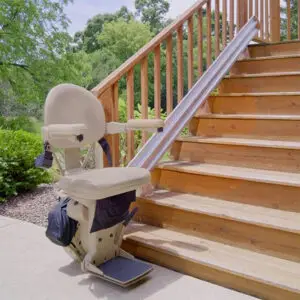
A beige stairlift is installed on the side of an outdoor wooden staircase, surrounded by greenery and trees, providing accessible transportation up the steps.

Choosing a stairlift for your Michigan home starts with one fundamental question: what kind of staircase do you have? The answer determines which type of stairlift you need, what it will cost, how long installation takes, and which brands are even available to you.

Most homeowners assume this decision is complicated. It really is not — once you understand the key differences between a straight stairlift and a curved stairlift, the right choice usually becomes clear quickly.

What Is a Straight Stairlift?

A straight stairlift is designed for staircases that travel in a single uninterrupted line from one floor to the next — no turns, no landings where direction changes, no curves. These are by far the most common type of residential staircase in Metro Detroit and across Michigan, found in the majority of ranches, colonials, and bi-levels built in the region.

Because straight stairlift tracks come in standardized lengths that are cut down to fit during installation, the process is fast — typically completed in two to four hours. That standardization also keeps costs down. Most straight stairlift installations in Michigan run between $3,000 and $5,500, fully installed.

Leading straight stairlift brands include Bruno, Harmar, AmeriGlide, and Acorn. All offer models with varying weight capacities, seat styles, and features. We help Michigan families compare options based on their specific staircase dimensions, user needs, and budget — not based on what has the highest margin for us.
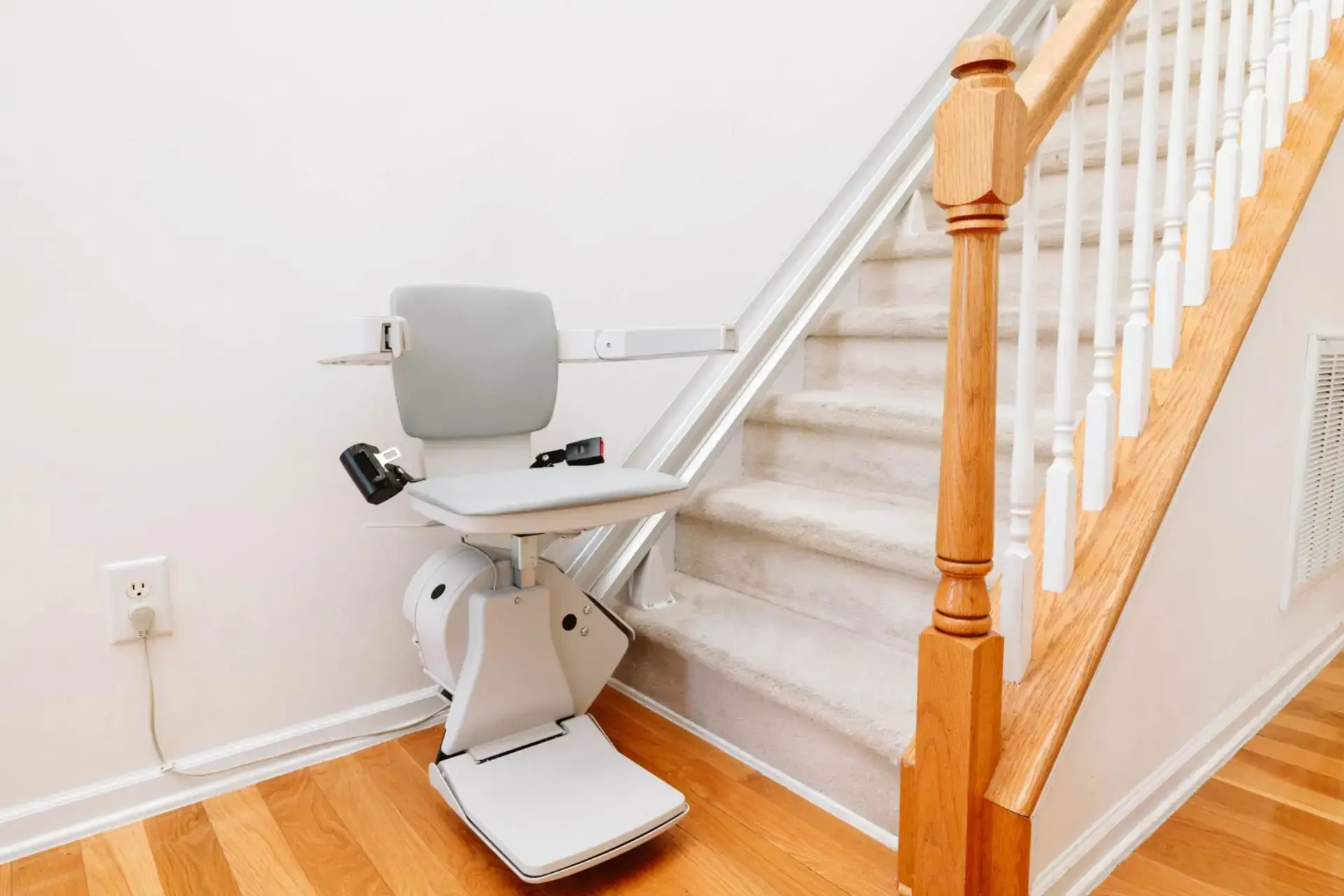
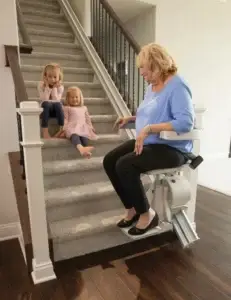
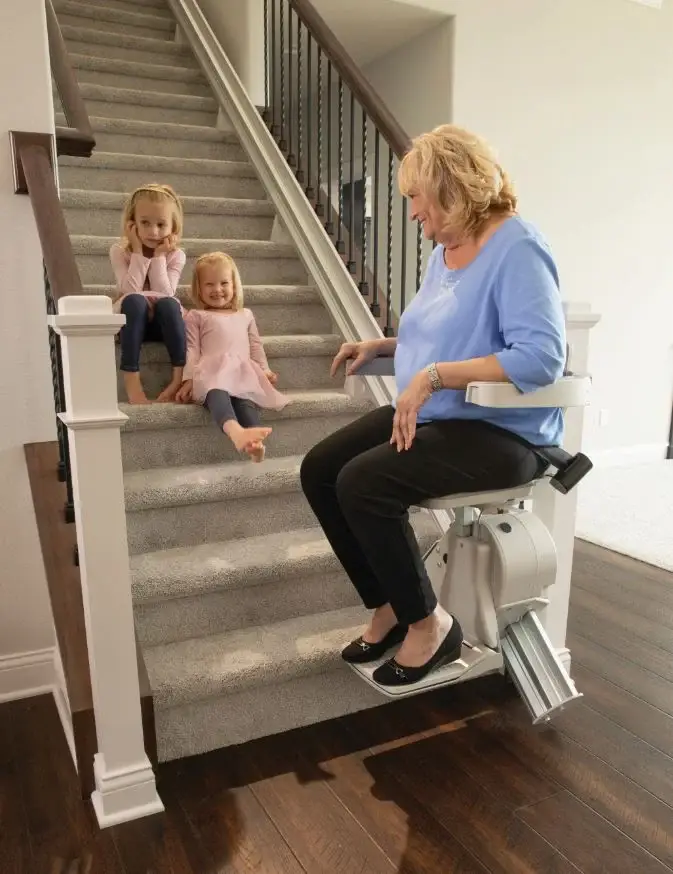
A motorized stair lift with a gray seat and armrests is installed alongside a carpeted staircase with a wooden handrail in a home with hardwood floors and white walls.

What Is a Curved Stairlift?

A curved stairlift — also commonly called a stairlift for curved stairs — is engineered for staircases that do not travel in a straight line. This includes staircases that:

  •       Make a 90-degree turn at a landing
  •       Make a 180-degree switchback turn
  •       Curve or arc gradually as they climb
  •       Spiral around a central column
  •       Include a winder section where steps are pie-shaped

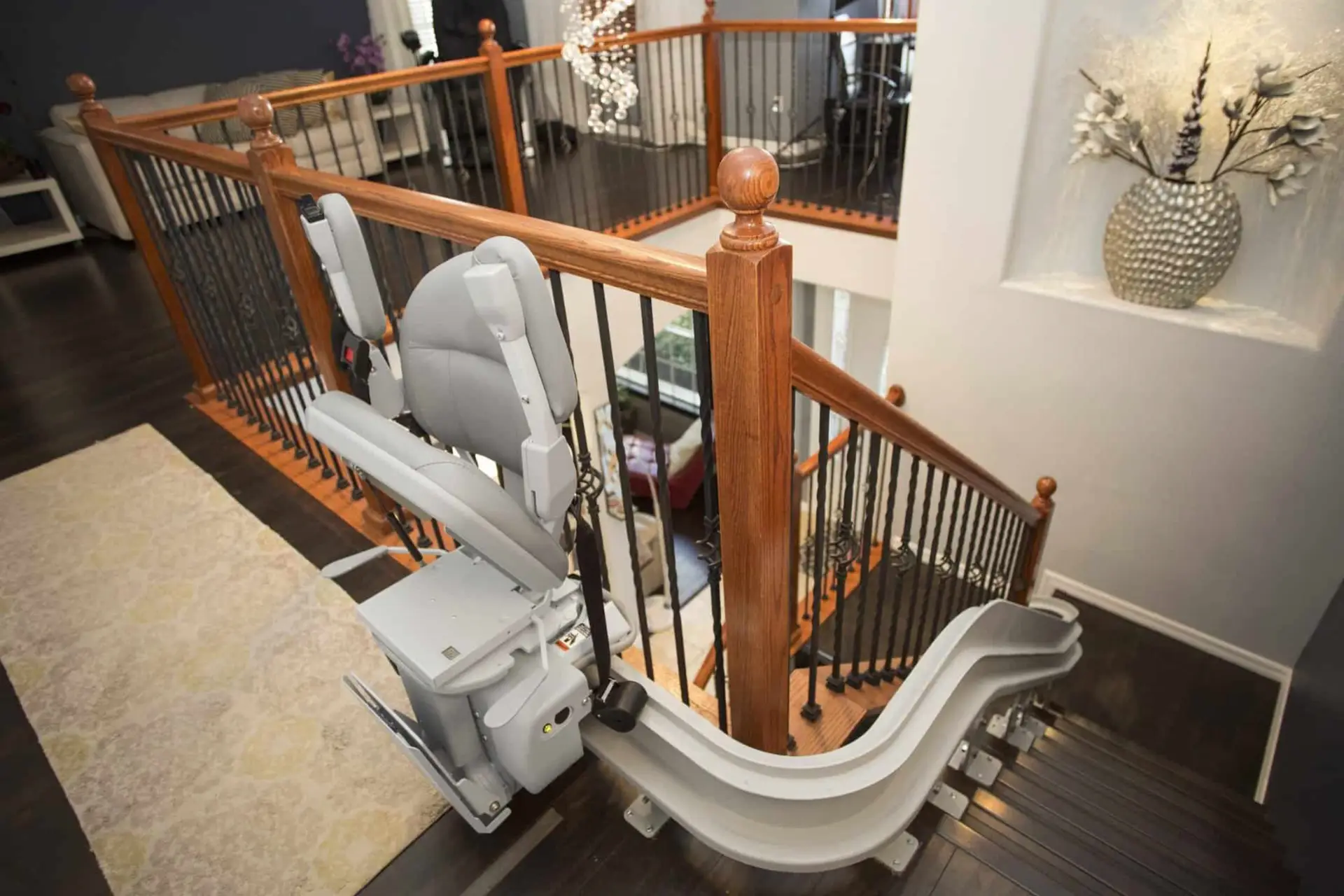
Because no two curved staircases are exactly alike, the track for a curved stairlift must be custom-fabricated to match the precise geometry of your specific staircase. A technician measures your stairs in detail, those measurements are sent to the manufacturer, and the track is built to order. This process takes two to four weeks from measurement to delivery.

Curved stairlift pricing reflects this custom work. In Michigan, expect to pay between $8,000 and $15,000 or more for a curved stairlift, fully installed. The significant price difference compared to a straight stairlift is entirely attributable to the custom track — the mechanical components are similar between the two types.

How to Tell Which Type of Staircase You Have

Stand at the bottom of your staircase and look up. Work through these questions:

Does the staircase go straight to the top without any change in direction? If yes, you have a straight staircase and are a candidate for a straight stairlift.

Is there a landing partway up where the direction of the stairs changes? If yes, you have a staircase with a turn. You may need a curved stairlift — or potentially two straight stairlifts connected by a transfer at the landing.

Does the staircase arc, curve, or spiral as it climbs? If yes, you have a curved staircase and will need a custom curved stairlift track.

Are any of the steps triangular or pie-shaped (winder steps)? Winder steps require a curved stairlift track even if the staircase visually looks relatively straight.

If you are unsure, do not guess — a free in-home measurement costs you nothing and eliminates any ambiguity.

Two Straight Stairlifts vs. One Curved Stairlift

This is a question many Michigan families never think to ask, but it is worth understanding. For staircases with a 90- or 180-degree landing, installing two separate straight stairlifts — one on each flight — is often significantly more cost-effective than a single curved stairlift.

The tradeoff is a brief transfer at the landing between units. The user rides the first lift to the landing, stands and takes a step or two to the second lift, and rides the remainder of the way up. If the user has enough mobility to manage those few steps safely, a two-unit straight configuration can save $3,000–$7,000 compared to a curved stairlift.

The two-unit approach also has a practical advantage: if one unit needs service, the other is still operational, and the user can manage the one-flight section more easily than being stranded with a fully inoperable curved stairlift.

We will always present both options when a landing is involved so you can make an informed decision. There is no wrong answer — it depends on the user’s mobility level, the width of the landing, and budget.A stairlift with a gray seat and backrest is installed along a curved staircase with dark wooden steps and railings. The stairlift track runs alongside the staircase, designed for safe movement between floors.
Important Staircase Measurements to Know

Regardless of staircase type, a few measurements help determine whether a stairlift is feasible and which specific model fits:

Width. Most stairlifts require a minimum of 28–30 inches of staircase width. Narrower staircases may still be accommodable with slim-rail models, but it requires careful selection.

Rise and run. The total height of the staircase and the depth of each tread determine track length and whether any custom fabrication is needed even on a straight staircase.

Headroom. Low ceilings at the top of the staircase can affect the stairlift’s ability to travel all the way to the upper landing. Our installers check this during every site visit.

Doorway clearance. On many Michigan homes, a door sits at the top or bottom of the staircase. Fold-flat rail options ensure the stairlift does not block doorway access when parked.

Which Brands Do We Recommend?

For straight stairlifts, Bruno and Harmar are our most-recommended brands for Michigan homeowners based on reliability, parts availability, and warranty support. Both offer models across a range of price points and weight capacities.

For curved stairlifts, Bruno’s Elite Curved is a strong choice for Michigan homes. The track fabrication quality is excellent, the ride is smooth, and Bruno’s service network across Michigan is well-established.

We are not brand-exclusive — we will tell you honestly if a different model serves your situation better.

Get a Free Stairlift Assessment in Michigan

At Senior Home Solutions, we do every staircase assessment in person. We measure carefully, review the full staircase configuration, and present every viable option — straight stairlift, curved stairlift, or two-unit configuration — with transparent, installed pricing. No pressure, no obligation.

We serve Metro Detroit and communities across Michigan. Call us at 586-980-0049 to schedule your free assessment. The right stairlift depends on your stairs, your needs, and your budget — and we will help you find it.

 

Outdoor Stairlifts for Michigan Homes: Handling Snow, Ice, and Harsh Winters

Michigan winters are not gentle, and they are not forgiving. Between lake-effect snowfall, black ice that forms overnight, and temperatures that regularly drop into single digits or below zero, exterior stairs become genuinely hazardous for seniors and anyone with limited mobility from November through March. Falls on icy outdoor steps are one of the leading causes of serious injury among older adults — and one of the most preventable.

An outdoor stairlift provides safe, motorized access to exterior stairs year-round. But Michigan homeowners rightfully want to know: can a stairlift really hold up to a Michigan winter? And how do you choose the right exterior stairlift for your specific home?

What Makes an Outdoor Stairlift Different from an Indoor One?

An outdoor stairlift — also called an exterior stairlift or weatherproof stairlift — is a fundamentally different product from an indoor unit, not just the same lift with a cover over it. Standard indoor stairlifts will corrode, seize, and fail within a single Michigan winter if installed outside. Outdoor models are purpose-built for exterior exposure from the ground up.

Key differences in an outdoor stairlift designed for Michigan conditions include:

  •       Marine-grade or powder-coated aluminum rail systems that resist rust, surface oxidation, and galvanic corrosion from road salt exposure
  •       Fully sealed motor housings and drive systems rated for moisture ingress, ice formation, and freezing temperatures
  •       Electronics rated for operation in extreme cold — some models are tested down to -20°F
  •       UV-stabilized housing and seat materials that resist cracking, fading, and degradation through Michigan’s freeze-thaw cycles
  •       Weatherproof covers for the seat, armrests, and controls when the unit is parked and not in use
  •       Battery backup systems with cold-weather-rated batteries that continue operating during power outages — critical during Michigan winter storms when power loss and the need for stair access can coincide

How Outdoor Stairlifts Perform in Michigan Snow and Ice

The most common question we hear from Michigan homeowners researching an exterior stairlift is whether the unit will operate when the stairs are covered in snow. Here is the honest answer from a company that has installed outdoor stairlifts across Metro Detroit and Michigan for years.

A properly specified weatherproof stairlift will function in cold temperatures and light to moderate snow accumulation. The drive mechanism is sealed and the rail is designed with an open profile to prevent significant snow packing in the track. However, for heavy snow accumulation — the kind that would make the stairs impassable on foot — the rail and stairs should be cleared before operating the lift. This is not a design limitation; it is basic safety practice, the same as you would shovel before walking the steps yourself.

Ice is a different matter. Road salt and ice melt products should not be applied directly to the stairlift track, as they can accelerate corrosion even on weatherproofed components. Instead, we recommend keeping the landing and departure areas clear with sand or a non-corrosive ice control product, and using non-slip step inserts on the stairs alongside the rail. Most outdoor stairlift manufacturers also offer heated footrest options on select models, which adds meaningful comfort during cold-weather operation.

A beige stairlift is installed on the side of an outdoor wooden staircase, surrounded by greenery and trees, providing accessible transportation up the steps.

Where Are Outdoor Stairlifts Most Commonly Installed in Michigan?

Across Metro Detroit and Michigan, we install exterior stairlifts most frequently in the following locations:

Front porch entry stairs. The most common application. Many Michigan homes — especially ranches, bungalows, and older colonials in Wayne, Oakland, and Macomb counties — have 4 to 12 steps from the driveway or sidewalk level up to the main entry. When icy, these stairs become a genuine fall hazard.

Side-entry garage stairs. Bi-level and tri-level homes often have an exterior stair entry from the garage into the main living level. These are frequently shaded and north-facing, making them among the first surfaces to ice over and the last to clear.

Rear deck and patio stairs. For Michigan homeowners who want to maintain access to their outdoor living space through four seasons, an exterior stairlift on the deck stairs extends safe access well into fall and back into spring.

Commercial and community entries. Churches, community centers, and small businesses across Michigan use outdoor stairlifts where ramping is impractical due to space constraints or architectural restrictions.

Outdoor Stairlift vs. Exterior Ramp: Which Is Right for Your Michigan Home?

Both exterior ramps and outdoor stairlifts are valid accessibility solutions, and at Senior Home Solutions we install both. The right choice depends on your specific property, the user’s mobility level, and practical constraints.

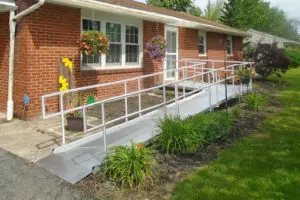
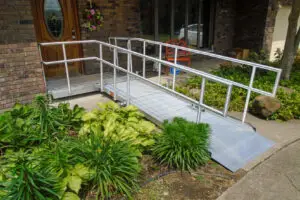
Space requirements. ADA-compliant ramps require 12 inches of horizontal run for every 1 inch of rise. A front entry with 36 inches of rise needs a 36-foot ramp. Most Michigan residential lots cannot accommodate this, particularly on urban or suburban properties with small front setbacks. An outdoor stairlift requires only the footprint of the stair tread itself.

Wheelchair dependency. Full-time wheelchair users are generally better served by a ramp, which allows the wheelchair to travel directly without requiring a transfer. Stairlifts require the user to transfer from a mobility device to the lift seat and back — manageable for many people, but not for everyone.

Visual impact and HOA considerations. Exterior ramps are visually prominent and some Michigan HOAs or local ordinances restrict their installation. An outdoor stairlift has a significantly smaller footprint and is often the more acceptable solution in regulated communities.

Budget. A modular aluminum ramp in Michigan typically runs $3,000–$6,000 for a standard entry application. An outdoor stairlift runs $4,500–$8,000 installed. For entries requiring significant ramp length, the cost difference narrows considerably.

Outdoor Stairlift Installation in Michigan: What to Expect

Most exterior stairlift installations are completed in two to four hours. Our technicians anchor the track securely to the stair structure using weatherproof hardware, route power to the unit through a protected conduit, and run the lift through a full operational test before leaving. We also cover winterization best practices specific to your installation — how to clear the rail, when and how to apply lubricant, and how to operate the battery backup if needed.

Outdoor stairlift costs in Michigan typically run $4,500–$8,000 installed depending on staircase length, model, and features. We provide free in-home assessments and all-in quotes with no hidden fees.

Annual Maintenance for Michigan Outdoor Stairlifts

We recommend a pre-winter service visit for every outdoor stairlift in Michigan. This includes cleaning and lubricating the rail, inspecting all seals and housing joints, testing the battery backup system, and checking mounting hardware for any movement after a season of freeze-thaw cycling. A 45-minute annual maintenance visit is far less expensive than a mid-winter service call or a premature unit replacement.

Schedule Your Free Outdoor Stairlift Assessment

If exterior stairs have been limiting safe access to your Michigan home, we can help. Senior Home Solutions serves Metro Detroit — Wayne, Oakland, and Macomb counties — and communities across Michigan with outdoor stairlift installation, annual service, and genuine follow-up support.

Call us at 586-980-0049 to schedule your free in-home assessment.

Do not let another Michigan winter make your front stairs a hazard.

Rapid Response with Zero Compromise on Quality

Don’t leave your accessibility project to chance, work with the experienced, highly specialized team at Senior Home Solutions.  We will respond to your need immediately, have your back through completion and 100% safety. And we will be there for you beyond the install!

Don’t leave your accessibility project to chance, work with the experienced, highly specialized team at Senior Home Solutions.  We will respond to your need immediately, have your back through completion and 100% safety. And we will be there for you beyond the install!